Sunday, 25 August 2024

"I Don't Like Mondays," - Weekly Reflection 25th August 2024

In the summer of 1979, "I Don't Like Mondays," a song by Irish new wave group the Boomtown Rats about the Cleveland Elementary School shooting in San Diego became the sixth-biggest hit of the UK in that year.

According to Geldof, he wrote the song after reading a telex report at Georgia State University's campus radio station, WRAS, on the shooting spree of 16-year-old Brenda Ann Spencer, who fired at children in a school playground at Grover Cleveland Elementary School in San Diego, California, on 29 January 1979, killing two adults and injuring eight children and one police officer. Spencer showed no remorse for her crime; her explanation for her actions was "I don't like Mondays. This livens up the day".  Her flippant response attracted a lot of media attention and inspired the song.

On Friday last at St Andrew’s Discussion Group, we were exploring a familiar passage from Ephesians 6. 10-20, known as ‘The Whole Armour of God.’  

The question in my mind and one we circled back to several times relates to verses 11-12. ‘Put on the full armour of God, so that you can take your stand against the devil’s schemes. For our struggle is not against flesh and blood, but against the rulers, against the authorities, against the powers of this dark world and against the spiritual forces of evil in the heavenly realms.’

Could it be that when a human does something that is so horrific, particularly to another human, that we struggle to process that action as having any ‘human origin?’ Therefore, its source must lie outside – ‘the powers, rulers and authorities – the devil, the Satan.’

One of the golden rules in any prison visiting is not to ask about the reasons why someone is in prison or why they did what they did.  That all makes good sense in a prison setting. And yet I think we would like to know. We would like to know so that we might have a better insight and able to process what happened and possibly why. Maybe, with such an insight we might be able to take measures to try and avert a repeat of whatever happened.

And isn’t it almost intuitively that we say to child who has hurt someone, ‘why did you do that?’

Means – Motive – Method.

‘Now, not many children I have come across, would blame an outside ‘force’ – certainly not a demonic force active in the heavenly realms. They may for certain blame someone else who goaded them, or encouraged, or even bullied them into doing something wrong.

Chillingly, for some, it is simply because 'they don't like Mondays.' 

And there are those who do blame an agency ‘outside of themselves.’  Firstly, mental health/illness must come into play here in seeking a better understanding.  

But as a reader of the Bible, and as someone who seeks to live within the framework of the Scriptural Narrative, the Satan, the powers, ruler and authorities are clearly very much part of the story.

But what authority and what power do these forces have?

We read in, Matthew 28.18 And Jesus came to them and said, “All authority in heaven and earth has been given to me.”

Ephesians 6 comes as a summation of Paul’s argument throughout this letter and in Ephesians 2.6 we read, ‘For he raised us from the dead along with Christ and seated us with him in the heavenly realms because we are united with Christ Jesus.’  Allow that thought to sink in deep  - united with Christ ‘who has all authority in heaven and on earth!’

There is a lot, an awful lot more to be said, explored and discussed than is possible in a short reflection like this.

And I would like to encourage such a deeper exploration of what it might mean when we say, ‘For our struggle is not against flesh and blood, but against the rulers, against the authorities, against the powers of this dark world and against the spiritual forces of evil in the heavenly realms.’

Working within this paradigm can help us look behind the ‘evil actions’ that some people do.  We are encouraged to see a broader, bigger and fuller picture.  Engaging with the full corpus of the Scriptures can help us to see more clearly the bigger picture.

We do however need to be carful that such a thinking on our part does not give everyone an automatic ‘Get Out of Jail Free’ card.  There still must be a place for culpability and taking responsibility. This is in part, what the Sycamore Tree course explores, coupled with restorative justice. Sycamore Tree - Prison Fellowship

Above all, an engagement with the Scriptures will inform us that everyone is made in the image of God – the Imago Dei.

This Imago Dei, this ‘child of God, may be wicked, damaged, broken, brutalised, and yes, maybe under some sort of demonic force – but surely never, ever beyond redemption.  Never, ever beyond hope of becoming a full, flourishing human being.

Who, along with us, can stand clothed with the full armour of God on Monday or any other day.

Clothed so that we can withstand the ‘enemy’ – who only comes to steal and to rob, to bring pain and misery and imprisonment and enslavement.  

"I Don't Like Mondays,"

https://youtu.be/SaHAvEEbQOE?si=GnOCHb-BgytskUUy


Sunday, 18 August 2024

'Companionable Silence' - weekly reflection 18th August 2024

There is a well-known story that anyone who has engaged in any study of prayer or spirituality will have come across.  The story is told of John Vianney a priest at Ars (1786- 1859) encountering an old man staring at the Tabernacle in the small village Church. (The ‘Tabernacle’ is the place where the Reserved Sacrament is kept) He asked the old man what he was doing. So, the old man looked at his parish priest and explained the heart — and essence — of all prayer in one immortal sentence:

“I look at him, and he looks at me.”

I remember reading of a mother and daughter in a restaurant. The mother wanted to take an opportunity to teach her daughter a life lesson as she moved towards marriage. So, the mother asked the daughter if she could tell who amongst the dining couples were married.  The daughter said, is it those wearing wedding rings.  Well yes, said the mother, if your eye-sight is that good you might tell that way. But just look at the way the older couples are sitting in companionable silence. And if you look carefully, you can see that it is companionable silence and not contemptible silence.  The younger couples have so much to say to each other, so much to find out and discover about each other. (Sadly mobile phones have taken something of this away!)

After 42 years married one of things that amuses Jane and me is the way we seem to have begun to look alike.  And then there are those moment where we act to say or do something together almost by instinct or intuitively.   

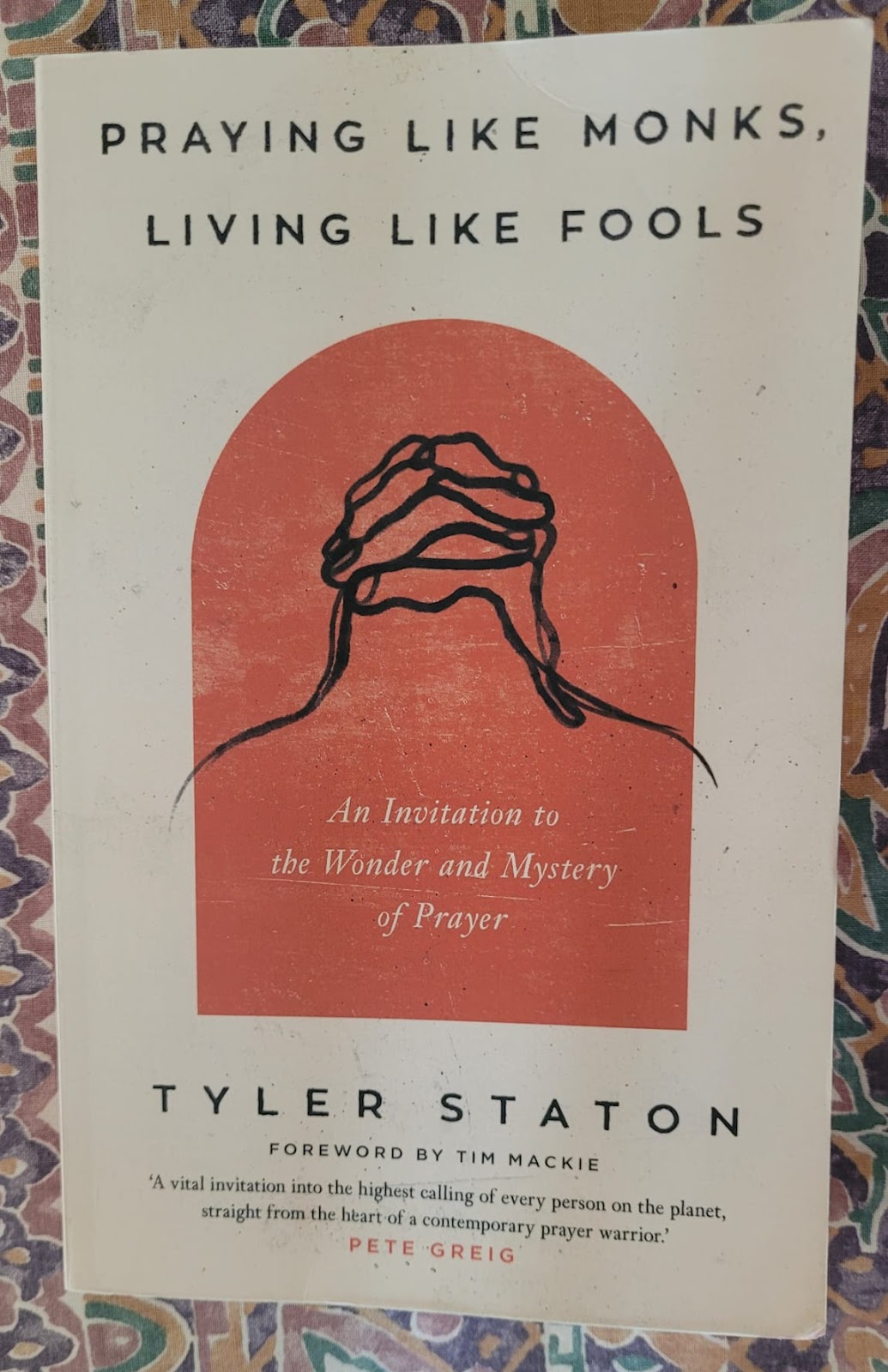
I have just read an excellent book ‘Praying Like Monks, Living Like Fools: An Invitation to the Wonder and Mystery of Prayer’ by Tyler Staton and I can’t recommend it highly enough. Tyler argues persuasively that the focus of prayer is about developing a relationship with God. 


When we first embrace the Christian Faith we often chatter away to God and bring very many verbal prayers.  Then life settles in and there is a need for fidelity. To keep on keeping on when it might all seem ‘a bit boring.’  However, if we remain faithful the rewards of a developing relation will be that we begin to look like Jesus and to act like Jesus. We will find that we can sit in companionable silence, because we have learned over the years to trust that God has our best interest at heart and that He loves us.

You may recall a time a few years ago when the phrase WWJD – What Would Jesus Do was very popular, particularly on wrist bands.

Last weeks podcast from the Bible Project (www.bibleproject.com) continued the exploration of the Sermon on the Mount. Tim and John were unpacking – Ask, Seek, Knock. What is fascinating is that if we look carefully in the context where this comes, we will find it comes after teaching about getting our relationships right with each other. The, ask, seek and knock are asking for wisdom in how to make the right call in judgment, when it is right to judge and call someone to account, and when not and above all to recognise our own faults and failings. This recalls Solomon’s call for wisdom so he could judge wisely.  As ‘apprentices’ to Jesus, to use John Mark Comer’s words, in his book, ‘Practising the Way,’  we are to be with Jesus, become like Jesus and do the things Jesus did.

Our aim ought to move beyond having to consider WWJD and to know instinctively and intuitively what Jesus would do.  

‘…until we all reach unity in the faith and in the knowledge of the Son of God and become mature, attaining to the whole measure of the fullness of Christ.’

Ephesians 4.13.

This ‘becoming as Christ’ is something more readily understood and embraced by the Eastern Orthodox Church under the title ‘theosis.’ This is a link to a useful short article explaining a little of what is meant by this term and this aspiration ‘to attain to the whole measure of the fullness of Christ.’ Understanding Theosis - Orthodox Road

We have been looking after James and William our five-year grandchildren for the weekend. This enabled their mum and dad, Peter and Tabitha, to enjoy a child free romantic weekend in Stratford-upon-Avon.  As five-year-old boys they are full of chatter and ‘demands’ of various kinds. They are full of chatter about what is happening around them and they want to tell you. But then there are those times when they simply snuggle up to you, the chattering stops, maybe it is watching something on TV, but there is a deep companionship that happens that is simply wonderful.  

When was the last time you stopped chattering, stopped bringing ‘demands’ and simply snuggled up to Father God for no other reason than because you loved Him, and you know He loves you. When “you looked at him, and he looked at you”  Where you have learned what it means to sit in companionable silence.


Sunday, 11 August 2024

' But we've always done it this way' - Weekly Reflection 11th August 2024

I heard a very funny story on Friday at the Bible study at St Andrew’s. I hope I heard it correctly as I am still struggling with swimmers’ ear which is affecting my hearing.

However, the story went something like this. A young woman was preparing a lamb shank but before placing it into the roasting tin, cut off an end.  She was asked why she did this. To which she responded, because that’s what my mum always did.  Further investigation revealed that this had been passed down several generations. And yet further questions revealed the original reason why the lamb shank had a section cut off. Several generations ago, the family had a roasting tin that wasn’t big enough and so a piece was cut off. This became a tradition passed down the family, but the reason got lost by successive generations.

Now, if you have ever watched the the impressive ceremony of the Evzones in Athens you will know something about a strange tradition. Well, strange to us to look at. 

But everything, right down to the number of pleats in their kilts has a story to tell and a tradition to uphold.

Today at St Oswald’s we were exploring Matthew 15 as part of our Sermon Series on following Jesus, doing what Jesus did, and becoming like Jesus.

This is a story about tradition, something that Pharisees knew a lot about and put a lot of effort into maintaining.


It is a point easy to miss, but the chapter opens with an introduction of some Pharisees and Scribes who had come to check out Jesus – to do so they would have travelled about 100 miles depending on which route they took.

And the first question to Jesus isn’t about the Scriptures but about keeping the traditions. The one they start with is washing of hands. Think about that – they have travelled 100 miles, not an easy journey, just to ask Jesus why his disciples are not washing their hands before dinner!

The ensuing debate is set in a typical rabbinical style. Eventually Jesus pushes back by asking them about the ‘tradition’ of corban. This is the tradition that allowed someone to say to their parents, “what I would have used to support you, is dedicated to God.”

Jesus then reminds them that honouring parents is one of the ten commandments.

Jesus says that they are placing their tradition about the word of God, above the Scriptures.


Traditions can be good; they can help tell a story about a former generation who had a smaller roasting tray or the 400 folds in the skirt of Evzones that represent the 400 years of Ottoman occupation of the country. 

Sadly, there are some traditions that carry a legacy of antagonism or even hatred for someone or some other people group. There might also be a tradition of ensuring that if someone hurts anyone in this ‘group’ there will be pay back.

Traditions can be fun, they can help us make sense, they can tell a great story, there is a lot of good things about traditions. But they can also be toxic, harmful and destructive.

The well-meaning Pharisees got themselves tied up in so many knots as they sought to maintain the traditions. 

Think for a moment of the ‘tradition’ of honour killing.

We need to be careful we never place any tradition above the authority of Scripture.

At the ‘softer’ edge that might be that in work there is a ‘tradition’ that people do certain things, add a little extra to the milage, leave early on Friday, take some stationary. 

Or in the case of my first employment as an Apprentice Jockey. There was a long standing ‘tradition’ that the new apprentices would be bullied and teased and made to run errands, to put bets on at the bookies and the like. Put bluntly, in today’s understanding, I was abused, sexually and physically. The older boys were just having their fun! This was part of the traditional culture when young males lived and worked together. I would like to think this has stopped, but wouldn't be so sure.  And it was generally understood that new apprentices, once into their second year and older would continue this ‘tradition.' I was not a Christian but like to think I was at least a reasonably kind human being and therefore did not carry on this tradition.

And I now know that there would be no question at all that the Scriptures would totally condemn this particular type of tradition.   As they would other some other traditions. Therefore it is worth the effort of checking traditons against Scripture, which always takes precendence and can break the cycle of toxic traditions.  


Sunday, 4 August 2024

'God or Google' - Reflection 4th August 2024

I met with a friend recently who was struggling to process all the horror in Gaza, in Ukraine and other places across the world. And then another friend trying to make sense of the murders in Southport and the subsequent riots. Both were looking to Jesus, as revealed in Scripture for an answer. Something that would make sense and give a clarity for right thinking and possibly action.  I was reminded of the teaching from The Bible Project, especially this year as they are exploring the ‘Sermon on the Mount’ in Matthew’s Gospel. https://bibleproject.com/


One key aspect stressed is that the Scriptures are ‘wisdom’ more than they are ‘rules’, more ‘story’ than ‘direct answers.’

This is picked up by Jesus who tells stories and parables in answering many of the questions put to him.  And this requires work on our part. It requires us to meditate, to chew over, and to discuss in community, what is the wisdom here, and how might this wisdom apply in this situation we are currently facing.   

It requires us not to take a ‘text out of context and make a pretext.’  I remember our Church Army College Principle who would encourage us when reading Scripture in public, in a Service or the like, to say ‘it is written in – the book of…’  It is not to be taken from or taken out of. (It could also be ‘to be found in.’)  A small point, but an important one and something I have remembered.  The Bible Project strap line is – ‘The Bible is a unified story that leads to Jesus.’


The other aspect of engaging with Scripture as wisdom literature and spending time pondering on it and meditating on it, both as individuals and as a community, is not dissimilar to those fire drills we take part in. Or indeed, any other practise for an emergency should one arise. The idea being that we will better be equipped to know how to act and what to do. 

1 Peter 3.15 ‘But in your hearts revere Christ as Lord. Always be prepared to give an answer to everyone who asks you to give the reason for the hope that you have. But do this with gentleness and respect…’

I am currently reading ‘Praying Like Monks, Living Like Fools: An Invitation to the Wonder and Mystery of Prayer’ by Tyler Staton. He mentions that on average most people will touch their phone 2,500 times a day.  (That doubles for the heaviest users!) That’s nearly one million touches a year. Some of this can lead to ‘doom scrolling’ feeding our fear and anxiety or FOMO (fear of missing out).

Staton puts forward that prayer is primarily about developing a relationship with God, rather than Google, X, Tic-Toc or Instagram, etc.  He advocates that we should seek to ‘chatter away’ to God about everything and anything all the time. (Cf. 1 Thess 5.17) 

Now imagine if for at least half of those ‘touches’ we looked at a short passage or a sentence of Scripture (whilst noting comments above about content and context.)  What difference might that make.

The question is, ‘who or what is informing our world view – God or Google?’


Scripture alone remains the true source of deep wisdom. However, wisdom also comes from our faithful forbears and as we travel through disturbing and difficult times this prayer from the 16th Spanish Mystic, Teresa of Ávila offers great comfort, challenge and wisdom.


Let Nothing Disturb You

Let nothing disturb you,
nothing shake you.
Everything passes,
God does not change.
Patience obtains everything.
Whoever has God lacks nothing.
Only God suffices.
Elevate your thoughts
to the heavens above.
Let nothing distress you,
nothing disturb you.
Follow Jesus Christ
with a big-heart,
and come what may
let nothing disturb you.
Do you see the glory of the world?
It’s vain-glory.
Nothing is stable,
everything passes.
Aspire unto the heavens
which last forever.
Faithful and rich in promises—
God never changes.
Love that which merits
an immense goodness.
But there is no pure love
without patience.
Confidence and a living faith
maintain the soul.
He who believes and hopes
obtains everything.
Even if it seems you’re besieged by hell–
he who has God will mock its fury.
Let it all come, then: desertions, crosses, disgraces.
If God is your treasure, you’ll lack nothing.
Begone, then, goods of the world and vain sayings.
Even if everything is lost,
God alone suffices.

St. Teresa of Ávila


Sunday, 21 July 2024

'Keys of the Kingdom' Reflection July 21st 2024

 'Keys of the Kingdom'


On Wednesday (17th July) we went along to see the ‘end of term play’ our granddaughter was taking part in, Year Six at Carglaze Primary School, St Austell, Cornwall. The play is a favourite for Key Stage Two children to perform, ‘The Pirates of the Curry Bean.’

This is a brief synopsis.

Anchors away and set sail for swashbuckling pirate adventure on the high seas in this piratical musical that's sure to shake your booty! Young twins Jack & Liza Periwinkle yearn for adventure, so imagine their joy at discovering a real-life treasure map! But when the infamous Redbeard and his pungent Pirates of the Curry Bean steal the map and kidnap their mother, the race is on to rescue her, reclaim the map and find the treasure!

Accompanied by their faithful cat Fiddlesticks, the twins join a mad admiral and his crazy crew on a voyage of adventure that takes them from Old London Docks to the mysterious island of Lumbago in the sea of Sciatica! Will they be first to find the treasure chest, or is a surprise awaiting them that's even better than gold? With colourful characters, sparkling songs and a witty script as sharp as a cutlass, this show is dripping with piratical style!

Pirates of the Curry Bean | Musical for KS2 Kids (musiclinedirect.com)

The Cornish accents also helped create the scene as did some local references which are encouraged.

It was great fun and a delight to see Kerryn playing her part along with the whole of Year Six.

Of course, there is a time when the treasure chest is found but it is locked and there is no key. And yet, one of the twins is carrying a strange locket that turns out to be the key.

This morning, (21st July) we joined the Church Family of St John’s in Stafford. We were part of this Church Family for five years and in some ways still are by extension. We travelled up on a Saturday to join in the birthday celebrations of Anne, one of the Churchwardens, and a very dear friend,  who celebrates her eightieth birthday on Monday 22nd July.  During refreshments afterwards (with birthday cake) there was a bit of confusion over where the church keys had gone, the ones Anne held,  she had given them to somebody who needed access somewhere.  They turned up okay and all was sorted.

St John’s have just begun a Sermon Series on Hebrews, we joined them on week two and Chapter 2 of Hebrews. However, rather than a detailed exposition of Chapter 2 we had an explanation of the background to the Book of Hebrews and why it may have been written and to whom it may have been written.  The answer to these questions remains as conjectures and the subject of ongoing scholarly debate. Therefore, we were offered one of those conjectures that appears very plausible and certainly helps unlock something of the complexity of this letter. (If indeed it is a letter, one suggestion is that it is a ‘sermon’ with greetings at the end.)

In short, the author is unknown and several ‘candidates have been suggested, including Priscilla and Aquila, which might account for the lack of an ascription as to the author.  As to the recipients it was intriguingly suggested that the ‘Hebrews’ may have been Jewish Christian living in Rome around AD 60 with Nero in the ascendancy and Christian’s being treated badly and ostracised if not yet suffering open and aggressive persecution. One way this ‘difficulty’ could be dealt with is for the Jewish Christians to return to the Synagogue, duly recognised by Rome, and publicly renounce faith in Jesus.   

This may be conjecture, although there is strong evidence of something like this, and once you grasp this concept the whole letter/sermon makes a lot more sense as it outlines in various ways how Christ it the ‘superior’ and the ‘better.’

I found this ‘key’ to opening Hebrews very exciting and enlightening.  

 (The Bible Project offers a great summation of Hebrews in this short video.)

Book of Hebrews Summary | Watch an Overview Video (bibleproject.com)

One of the outstanding features of prison is the keys and the importance of locking and unlocking, gates, door and cells.  For me, after any prison visit, it is one of those sounds that lingers in the memory.


In Psalm 84.10 we read,

‘Better is one day in your courts
    than a thousand elsewhere;
I would rather be a doorkeeper in the house of my God
    than dwell in the tents of the wicked.’

Not to put too fine a point on it, but simply put, some of those in our prisons have been living in ‘the tents of the wicked.’   Can we therefore become ‘doorkeepers’ and ‘key holders’ to enable them to move and come live in the ‘temple courts’ – in God’s presence.  To discover there, the richest treasure of all time.  

To discover that, ‘…we do not have a high priest (Jesus) who is unable to empathize with our weaknesses, but we have one who has been tempted in every way, just as we are – yet he did not sin.’  Hebrews 4.15

Stepping outside of prison what about those we meet in our daily lives. Are we alert that God might be asking us to offer a word, a resource, or something that would be a ‘key’ to a new understanding or maybe even a new way of living.  And are we open and attentive to ‘keys’ that may be presented to us, such as I had this morning regarding the Letter to the Hebrews.

 Many Christians across the world still suffer persecution to this day. And Hebrews is an encouragement for them to remain faithful.  For us though, our ‘neglect’ of the Faith can come in more subtle ways, step by step we slowly walk away as we are attracted by other things, maybe even by some of the perceived treasures and trinkets available in the ‘tents of the wicked.’  

 We need to be wary of this and, ‘… encourage one another daily, as long as it is called "Today," so that none of you may be hardened by sin's deceitfulness.’   Hebrews 3.13

And from Hebrews 10.24 ‘And let us consider how we may spur one another on toward love and good deeds.’ 

Now, where did I put my keys!


Monday, 15 July 2024

'On Yer Tod' - Reflection 14th July 2024

At 8pm on Saturday 13th July the St Austell, Athletic Running Club (STAARC) began a 24-hour run around a track at St Austell Cricket Club. Their aim was to raise funds for the Cornwall Air Ambulance. (A member of STAARC is one of the crew) Members of STAARC took one-hour slots.  The CAA is very close to Daniel’s heart and all the family, because if it wasn’t for the CAA Lowenna would not have made it to Bristol Children’s Hospital when she collapsed with a brain bleed.  Daniel picked up running with a passion a few years ago but has been badly hampered by asthma and other problems, some of them Covid related. As he knew I was down he invited me along to buddy up with him for an hour on Sunday, 5pm – 6pm. This worked out perfectly as it gave Daniel company, he pushed my pace on, and I pulled him back as it would only be natural for Daniel to try and run faster.  (They have gone over their £2,000 target and to date it is standing at £2,339)

In the morning, we attended Holy Trinity St Austell as they welcomed their new vicar, Jonathan Huff after a vacancy of several months.  


He preached on John 16.25-33. For me two things stood out. 

Verse 32 ‘” A time is coming and in fact has come when you will be scattered, each to your own home. You will leave me all alone. Yet I am not alone, for my Father is with me.”

This coupled with a question Jonathan put before us, ‘are you living for God or living with God.’ The emphasis being that we should seek to live with God. And therefore, if we are always living with God ‘we are never alone.’  

Jesus was in God and God was in Jesus. We read in 2 Corinthians 6: 18 “I will be a Father to you, and you will be my sons and daughters, says the Lord Almighty.”

And in the concluding verses of Matthew, the Great Commision, 'Therefore go and make disciples of all nations, baptizing them in the name of the Father and of the Son and of the Holy Spirit, and teaching them to obey everything I have commanded you. And surely I am with you always, to the very end of the age.”

If we are ‘in Jesus,’ then we inextricably linked with God the Father. And we are never alone!

 I found it helpful to have a reminder of this ‘basic’ Christian teaching and in particular to continue to reflect and seek to live into the call to ‘live with God’ rather than living for God.

In Genesis 2: 18 we read ‘The Lord God said, “It is not good for the man to be alone. I will make a helper suitable for him.”


This sets a theme that runs throughout the Scriptures.  We do however find ourselves at times ‘on our own’ because of various circumstances, getting older and bereavement is one of those. And we know that ‘loneliness’ is a real issue in the UK.  It is also something that some prisoners face as we see from time to time in our Prayer Line Request.

Two ‘takeaways’ – let us lean into and be grasped by a deep desire to live with God and know therefore that we are never alone.  Secondly, in the story of Adam, Eve was created as a companion.  May we be prepared to be the ‘presence of God’ in human form for someone who is alone.  That might mean running as buddy with someone for an hour, or perhaps something less physically demanding!


And by the way, you might search out the story behind 'on your tod' - which is rhyming slang for Tod Sloane, a 19th century American jockey who developed the short stirrups and the 'monkey crouch.'


Sunday, 7 July 2024

'Good News' - weekly reflection 7th July 2024

 ‘Good News’

I think I would be correct in saying that we all welcome good news. We heard some good news about our granddaughters in Cornwall this week. This is the good news Tracey (mum) shared with us…

Today we were completely caught off guard (in a lovely way). We were invited to a "family event for Guiding to announce the money raised from their fundraising" Nope!!! - instead, unbeknown to us Lowenna had been nominated for the Guiding Star Award! Everyone there except us knew what was going on. Totally unexpected, very lovely surprise and Lowenna is feeling very proud to be given this. Also, it was arranged for Kerryn to receive her Gold Brownie Award! Very proud of our girls.

Mark 1:14-15 ‘After John was put in prison, Jesus went into Galilee, proclaiming the good news of God.  “The time has come,” he said. “The kingdom of God has come near. Repent and believe the good news!”

Luke 9. 1-2 & 6

‘When Jesus had called the Twelve together, he gave them power and authority to drive out all demons and to cure diseases, and he sent them out to proclaim the kingdom of God and to heal the sick. So, they set out and went from village to village, proclaiming the good news and healing people everywhere.’

I remember the time when I looked at these verses and asked the question, what is the ‘good news’ being proclaimed here? Because this is all before Jesus’ death and resurrection!

Tom Wright explores this in his book ‘Simply Good News’ - Why The Gospel Is News And What Makes It Good.


This is also further explored in this essay, https://licc.org.uk/resources/jesus-died-to-save-the-planet/#

And this is all well encapsulated in Colossians 1.19-20

‘For God was pleased to have all His fullness dwell in Him, and through Him to reconcile to Himself all things, whether things on earth or things in heaven, by making peace through the blood of His cross.’

We have just had a ‘Green Weekend’ at St Oswald’s, Rugby. On the Saturday morning, we engaged in a Litter Pick before building a Bug Hotel. All of this was carried over into Sunday morning All Age Worship. We focussed on Psalm 24.1 ‘The earth is the LORD’s, and everything in it. The world and all its people belong to him.’

Pulling all these threads together we recognize that the ‘Good New’ the ‘Gospel’ is much fuller, richer and deeper than a single focus on Jesus’ death, resurrection and forgiveness of sins. Although that is deeply important. The ‘full’ Gospel is that Jesus died to save the planet (see essay above) and one day heaven and earth will be reconciled as described in Revelation 21 as a Wedding Feast.

Jesus proclaimed the Good News of God’s Kingdom come upon earth (cf: Lord’s Prayer) and his death and resurrection inaugurated that reality. The technical term is, ‘inaugurated eschatology.’  

The Genesis creation story speaks of Adam and Eve being called to be good stewards and seek the flourishing of all things upon earth.  Jesus comes as the ‘Second Adam’ – the obedient ‘Second Adam.’ And now through his death, resurrection and ascension to the right hand of God, all authority on heaven and earth has been given to Jesus. (Matt 28.18)

And picking up on John Mark Comer’s book ‘Practicing the Way' we are called to 'Be with Jesus, Become like Jesus and Do as Jesus did.'

"For Jesus, salvation is less about getting you into heaven and more about getting heaven into you."

And I would want to add it is getting heaven into all the places you go, into every word you speak, into every action you take, into every engagement you have with people - and the whole of creation.

Because ‘The earth is the LORD’s, and everything in it. The world and all its people belong to him.’


https://youtu.be/Uz5xbqU7msE?si=1ZbyNYY-OJbpQjc7